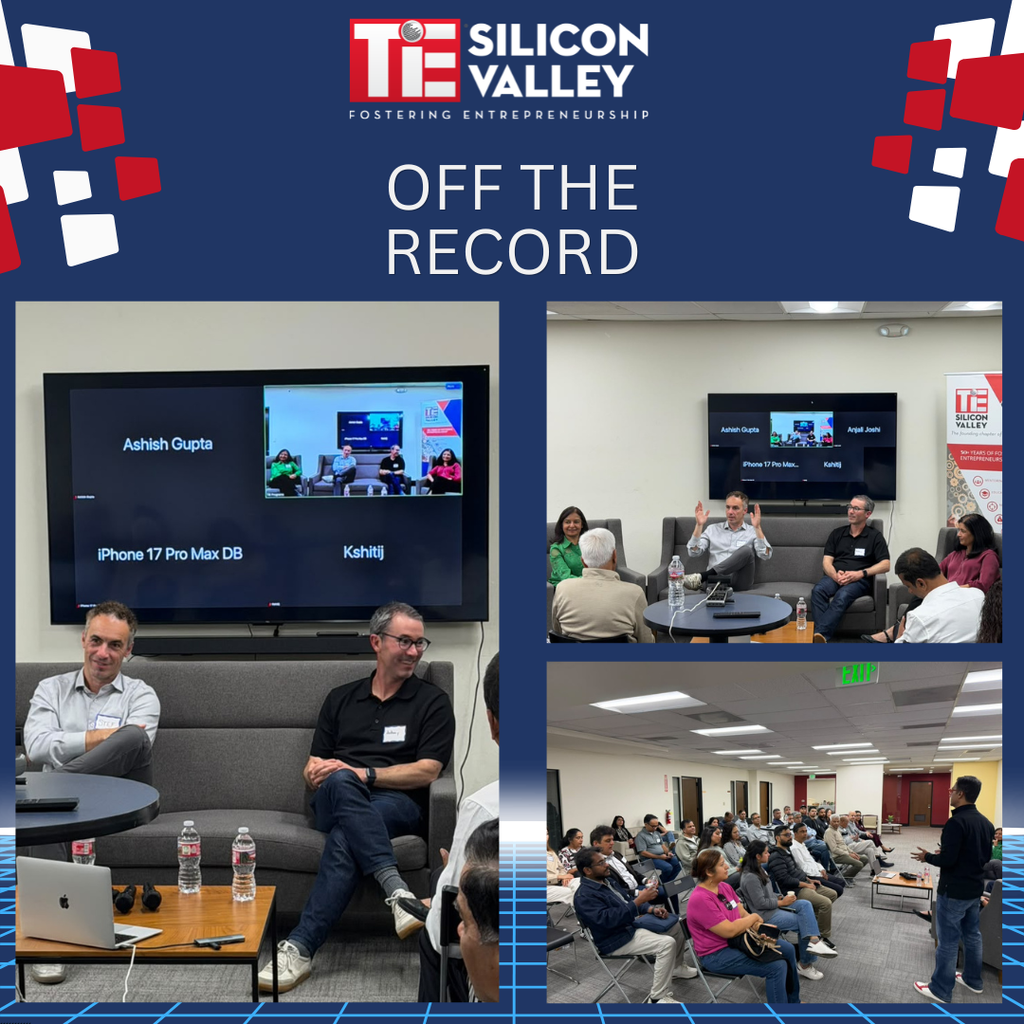
TiE Silicon Valley brings product leaders from Runway and Canva together for a candid conversation on AI product strategy, user adoption, and building lasting value.
As AI capabilities evolve at an extraordinary pace, one of the biggest challenges for founders and product leaders is no longer simply adding AI to a product. It is figuring out which capabilities genuinely improve the user experience, how to build products that people return to, and how to create sustainable business value in a rapidly changing landscape.
On October 14, TiE Silicon Valley hosted the latest edition of Off the Record: Firsthand Conversations for Entrepreneurs Navigating AI, bringing together experienced product leaders for an open, practical discussion on Adding AI to Your Product: What Worked, What Flopped.
The session featured Anthony Maggio, Chief Product Officer at Runway and former Chief Product Officer at Airtable, and Stef Corazza, Head of AI Research at Canva, whose work spans AI-powered creative tools, research, and product innovation. The conversation was co-moderated by Shivani Govil, Senior Advisor at McKinsey & Company, and Smita Hashim, Partner at Disruptive Ventures, strategic advisor, and former Chief Product Officer at Zoom.
With an engaged audience participating both in person at the TiE Silicon Valley office in Palo Alto and remotely, the discussion moved beyond AI announcements and theoretical possibilities to explore the real decisions involved in developing, deploying, and scaling AI-powered products.
Key Takeaways: Building AI Products for What Comes Next
1. Build for Where AI Is Going, Not Just Where It Is Today
AI models are improving at a remarkable pace. Product teams that design exclusively around today’s limitations risk building unnecessary complexity into their products.
Founders should start with the problems they want to solve for users and develop an ambitious vision for what the product could achieve as AI capabilities advance. This also means continually reassessing existing workflows, custom logic, and product architecture. Solutions that are necessary today may become constraints tomorrow.
The opportunity lies in building for the direction of technological progress while remaining flexible enough to adapt as capabilities improve.
2. Product Management Is Evolving Alongside AI
Traditional product development emphasizes prioritization, iterative releases, and delivering a minimum viable product. While these fundamentals remain relevant, AI is changing how product teams approach innovation.
Closer collaboration between product managers, engineers, and AI researchers can help transform emerging research into useful, differentiated products. Teams must also rethink how they gather feedback. Understanding customers remains essential, but evaluating how AI agents interact with a product is becoming increasingly important.
The result is a more ambitious approach to product development, grounded in technical understanding, experimentation, and continuous learning.
3. Give Users Enough AI to Experience Its Full Value
AI features need to deliver meaningful results before users can appreciate their potential. Limiting access or usage too aggressively can prevent customers from experiencing the benefits that drive adoption and retention.
At the same time, expanding AI usage must make economic sense. Falling inference costs, model selection, and optimization techniques are creating new opportunities to deliver more value efficiently.
For founders, the challenge is to balance two priorities: building toward the capabilities of future models while making the most of the models available today. Thoughtful experimentation with usage limits, infrastructure costs, and product experience can help teams find that balance.
4. Design for AI Agents as Well as Human Users
As AI agents increasingly search for information, compare solutions, and complete tasks, product design must account for a new kind of user.
Teams need to consider how effectively agents can navigate their products, access relevant information, and complete intended workflows. Observing where agents struggle and improving those interactions can become a valuable part of product development.
Discovery is also changing. Customers may increasingly encounter products through AI-powered conversations rather than traditional search or marketing channels, making it important for companies to be discoverable in these environments.
Yet accessibility alone is not enough. Products must give customers compelling reasons to stay, whether through persistent workflows, useful integrations, or capabilities that make the product an indispensable part of their work.
5. Revenue Matters, but Customer Value Comes First
Despite the rapid changes in AI, the fundamentals of building a business remain intact. Companies must demonstrate clear value, differentiate themselves in ways customers recognize, and develop business models that support sustainable growth.
Pricing remains a challenge, particularly when product value and costs are closely tied to usage. Founders must continue experimenting with pricing structures while ensuring that customers understand the value they receive.
The discussion also highlighted a broader shift in how teams operate. AI is enabling smaller teams to accomplish more, but leaner organizations can also make the work feel more isolating. As companies become more efficient, investing in people, maintaining strong customer relationships, and building healthy teams remain essential.
Technology may change how work gets done, but the importance of serving customers and supporting the people building the product does not.
An Open Conversation for the Entrepreneurial Community
The October session reinforced the purpose of Off the Record: creating a space where entrepreneurs can learn directly from practitioners who are building, deploying, and navigating AI in the real world.
Rather than polished presentations or product pitches, the series encourages candid conversations about difficult decisions, lessons from experimentation, and the realities of translating new technology into business outcomes.
The discussion offered founders and product leaders a practical reminder: successful AI products require more than access to powerful models. They demand ambitious product thinking, close attention to user behavior, sound economics, adaptability, and a relentless focus on delivering value.
TiE Silicon Valley extends its thanks to Anthony Maggio and Stef Corazza for sharing their experience and insights, and to Shivani Govil and Smita Hashim for guiding the discussion.