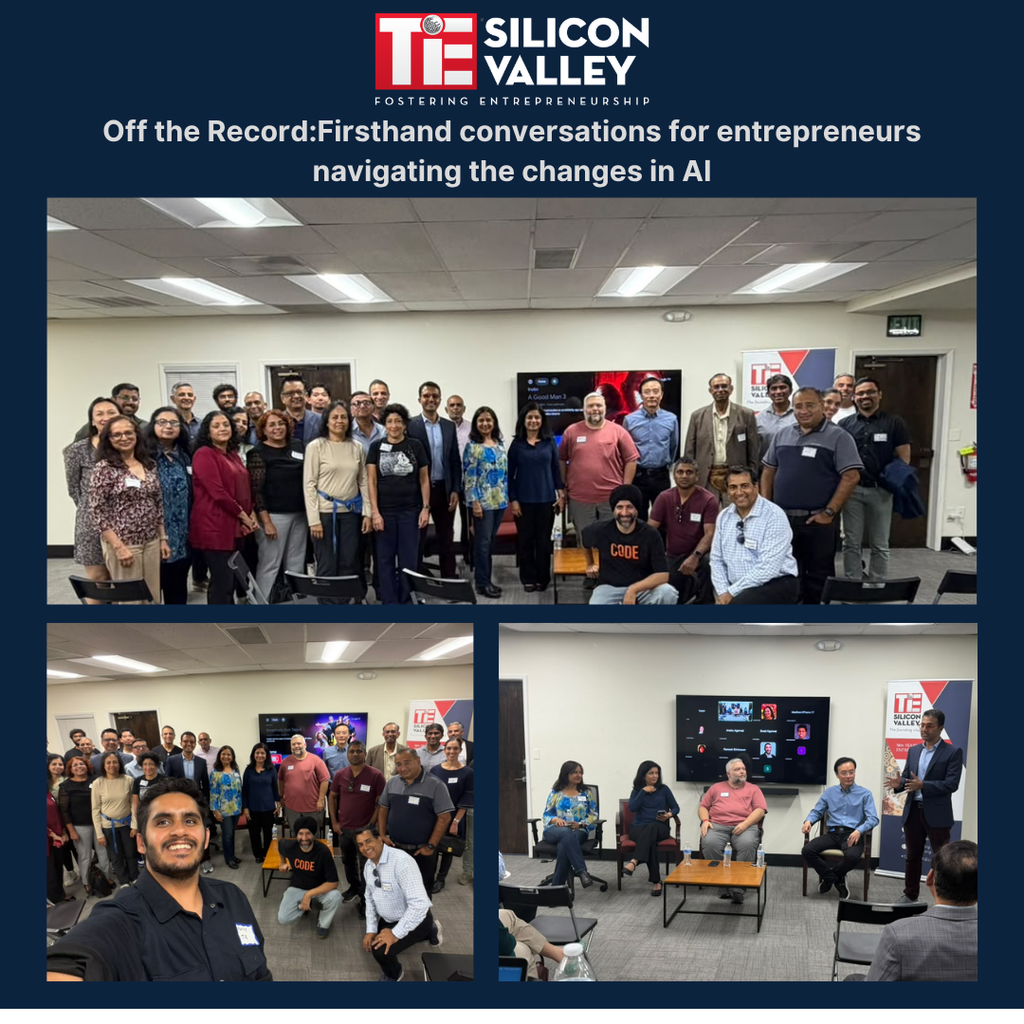
The software development lifecycle is undergoing its most radical shift in a generation. At TiE Silicon Valley’s inaugural Off the Record session, held under Chatham House rules to encourage candid sharing, curators Smita Hashim (strategic advisor, investor, and former CPO at Zoom) and Shivani Govil (Senior Advisor at McKinsey & Co.) brought together two exceptional tech leaders for a private, behind-the-scenes conversation.
The discussion featured Mu Han, Chief Development Officer at Zoom, bringing an enterprise-scale engineering lens, alongside Allen Hutchison, Founder of Vycari and former Google DeepMind Distinguished Engineer, sharing insights from the early-stage startup front lines.
While specific details remain off the record, the session highlighted several high-level themes, practical frameworks, and strategic realities shaping modern software creation.
1. Generalizing the Shift: A Whole New SDLC
The classic SDLC—specs, design systems, manual code reviews, and long release cycles—was built for a world of human-only velocity. Today, AI isn’t just an autocomplete tool; it’s altering every phase of development.
Rather than replacing developers, AI is shifting the engineer’s role from code author to systems architect and evaluator. The bottleneck in software development is no longer how fast a team can write code—it is how effectively they can guide, validate, and integrate AI outputs into cohesive systems.
2. Managing the Token Economy: Practical Economics
With LLM-driven development becoming standard, a major theme of the evening focused on the practical realities of token allocation and budget efficiency:
- Smart Model Selection: Engineering teams are increasingly adopting tier-based strategies. Simple boilerplate, syntax checks, and lightweight refactoring are routed to smaller, cost-effective models, preserving primary token budgets for complex reasoning and architectural design.
- Context Hygiene: Feeding massive repositories into large context windows can quickly inflate costs and introduce noise. Maintaining clean, highly targeted context slices proves far more effective for accurate outputs.
3. Navigating Local Models and Emerging Agents
The developer ecosystem is expanding at a dizzying pace. The conversation touched on how teams are adapting to the rise of specialized tooling and autonomous systems:
- Local AI Frameworks: Open-source ecosystems and local runtime tools like Ollama allow teams to maintain strict data privacy, reduce latency, and iterate locally without constantly hitting external APIs.
- Autonomous Workflows: Emerging agentic frameworks and tools like Luna signal a move away from simple side-by-side chat boxes toward background processes capable of tackling async tasks, testing, and initial pull request drafts.
4. Culture and Continuous Adaptation at Enterprise Scale
A key perspective shared during the session focused on how large organizations maintain momentum when underlying technologies update almost monthly.
Rather than relying on slow, rigid approval cycles, the most effective approach encourages engineering teams to actively test and integrate the latest tool versions as soon as they drop. When developers are empowered to experiment with frontier capabilities in real time, the entire engineering culture evolves continuously alongside the tech stack, avoiding the need for disruptive, late-stage transformations down the road.