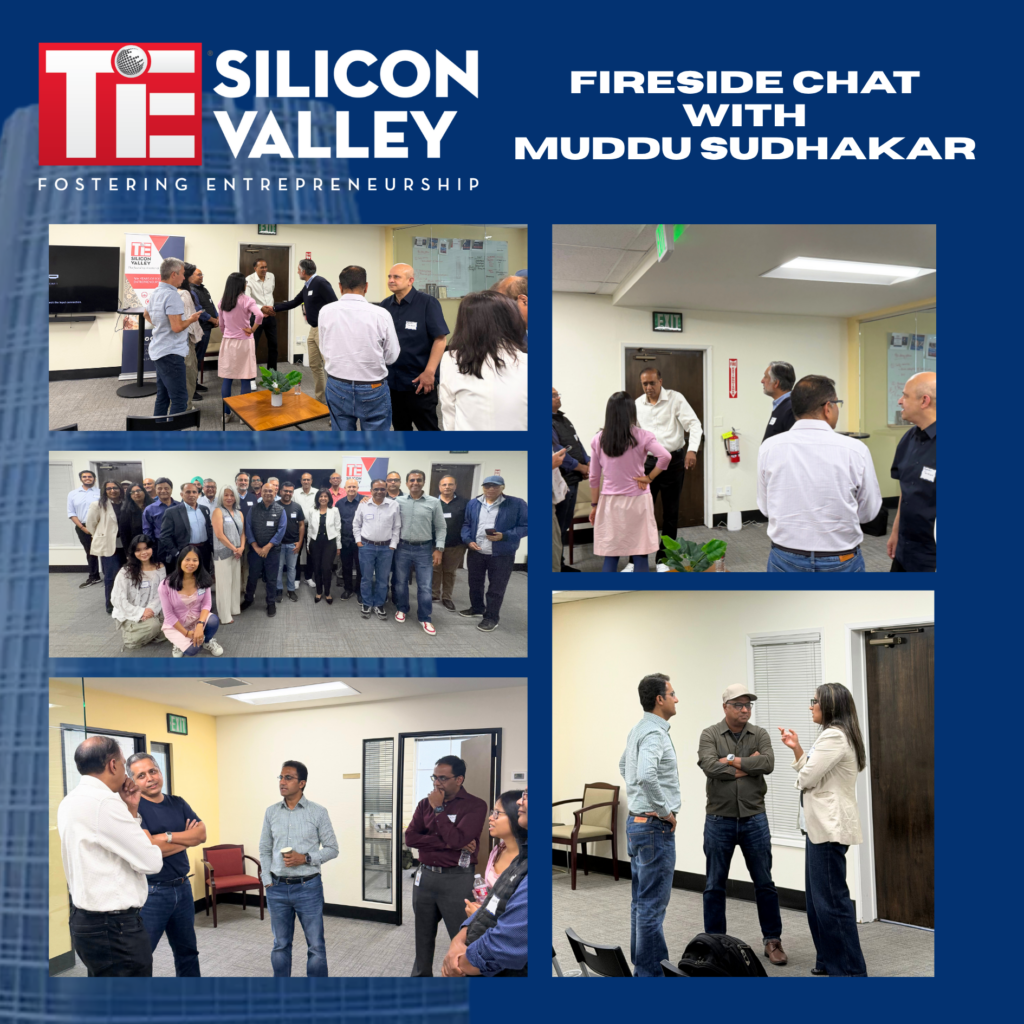
On August 20, 2026, members of the Silicon Valley technology and startup community gathered at the TiE Silicon Valley office for an in-person Fireside Chat with Muddu Sudhakar. Addressing an audience of founders, engineers, and venture investors, Muddu delivered a candid assessment of the current state of artificial intelligence, capital deployment, hiring realities, and structural shifts in enterprise software.
1. The $8 Trillion CapEx Wave & Shifting Bottlenecks
A central theme of the session was the sheer scale of capital being poured into AI infrastructure. Hyperscalers are currently spending close to $1 trillion in annual CapEx, a figure projected to scale to $8 trillion over the next five years.
Muddu emphasized that while 2024 and 2025 were dominated by GPU supply constraints, the technical bottlenecks are rapidly moving across the stack:
- Memory & Storage: High-bandwidth memory (HBM) and storage architectures have become immediate constraints.
- The Network Super-Cycle: 2026 is seeing network bandwidth emerge as the next major bottleneck. Because persistent AI agents generate 4x to 10x more network traffic than human users, current switching and routing infrastructure must be rebuilt from the ground up.
- Power & Data Centers: From neoclouds (such as CoreWeave and Nebius) to regional power grids, energy generation and data center operations are emerging as a distinct financial asset class.
2. The Return of the Hands-On Technical Founder
Addressing the employment market, Muddu pushed back on the narrative of a general “job apocalypse,” noting instead that active hiring is booming across California, India, New York, and the UK. However, the type of talent being hired has shifted drastically.
“If you are just a slide maker or a storyteller, you are not getting job interviews in this market. Value has aggressively returned to hands-on technical staff.”
Key takeaways on talent and founder expectations included:
- The Death of “Fluff” Roles: Non-technical support layers, ancillary roles, and generic management positions are disappearing. Core developers, product managers with deep technical understanding, and domain-specific sales leads remain in high demand.
- CEOs Must Write Code: Early-stage venture capitalists are increasingly scrutinizing founder-CEOs. If a founder CEO hasn’t checked in code to a repository or open-source project recently, securing seed or Series A checks is becoming significantly harder.
- Open Source as the Ultimate Resume: Committing to open-source projects using AI coding assistants like Cursor or Cloud Code is now the primary metric for verifying technical competency regardless of age or background.
3. “Build vs. Buy” and the Re-Engineering of SaaS
One of the most provocative parts of the discussion centered on how software is acquired and consumed:
- SMBs are Building Internal Tools: With AI coding assistants reducing development friction, small businesses no longer feel compelled to buy point-solution SaaS tools. A single engineer can maintain custom IT, HR, or operational tools tailored specifically to the company’s needs.
- Enterprises Demand Substrates and Ontologies: Enterprise buyers are moving away from generic startup applications. Instead, they prefer building on top of deep domain taxonomies, knowledge graphs, and agent frameworks (pointing to models like Palantir as gold standards).
- Outcome-Based Pricing: Per-seat SaaS models are under structural pressure as autonomous AI agents reduce human headcount. To survive, legacy and new SaaS vendors must transition toward consumption-based and outcome-based pricing models.
4. Operationalizing Jensen’s Law
Muddu closed with a practical rule for founders and product teams evaluating their technical velocity: AI performance is doubling every six months. If an AI startup’s core product is not doubling in capability—whether measured in latency, throughput, scale, or accuracy—every six months, it risks being rendered obsolete by the underlying infrastructure.